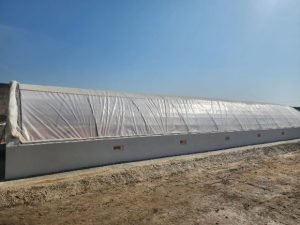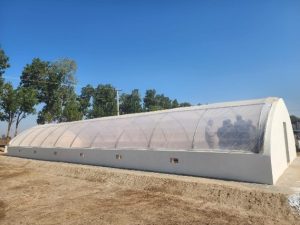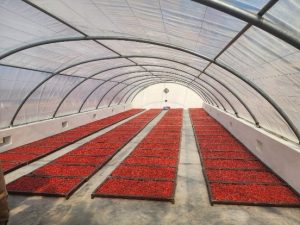


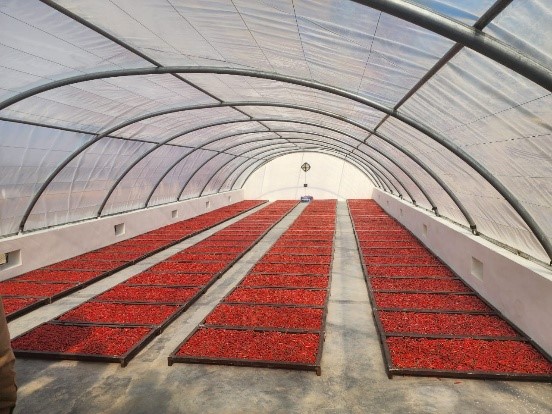
Chili is one of Pakistan’s most strategic spice commodities, with Sindh contributing the bulk of national production and Pakistani red chilies enjoying strong recognition for color, pungency and flavor. Yet a persistent and well-documented problem has held the sector back from realizing its export potential — aflatoxin contamination and Maximum Residue Limit (MRL) non-compliance arising from primitive open sun-drying practices on the ground, where chillies are exposed to fungal attack (Aspergillus flavus and Aspergillus parasiticus), insect damage, contamination, and inconsistent drying. Aflatoxins are recognised carcinogens with strict international permissible limits (under 5 ppb under WTO norms), and Pakistani chili consignments have repeatedly faced rejection or down-grading in premium destinations because of this single quality bottleneck.
PHDEC’s response has been to establish solar tunnel drying units distributed to chili growers across Sindh’s major producing districts — funded through the Export Development Fund (EDF) and rolled out in collaboration with the Arid Zone Research Centre (AZRC), Umerkot. The project covers 34 solar tunnel drying units sited across the province’s chili belt, providing a sustainable, low-operating-cost, scientifically-validated drying solution. Solar tunnel dryers maintain controlled airflow and temperature, materially reducing drying time, inhibiting fungal growth, preserving colour and capsaicin content, eliminating ground-level contamination, and producing uniformly dried chillies that meet international aflatoxin and MRL standards. PHDEC paired the equipment roll-out with a one-day technical workshop at AZRC Umerkot covering aflatoxin control, MRL compliance, and Good Agricultural Practices (GAP) for chili cultivation, ensuring growers have both the hardware and the know-how to operate it correctly.
The intervention directly targets the niche premium markets where Pakistani chili has been priced out by quality compliance issues — high-value EU and other destinations that demand traceable, residue-compliant, aflatoxin-free product. Beyond the immediate beneficiaries, the project serves as a demonstration model for sustainable, climate-friendly post-harvest infrastructure that can be scaled across other dried produce categories.
Objectives
- Eliminate aflatoxin contamination in Sindh’s red chili production by replacing open ground-level sun drying with controlled solar tunnel drying.
- Bring Pakistani chili consignments into compliance with importing-country Maximum Residue Limits (MRLs) and international aflatoxin permissible levels (under 5 ppb).
- Capture niche, premium export markets — particularly the EU — that currently reject or down-grade non-compliant Pakistani chili.
- Provide chili growers with a sustainable, low-operating-cost, climate-friendly post-harvest infrastructure that materially improves drying quality and consistency.
- Pair the equipment intervention with technical capacity building on aflatoxin control, MRL compliance and Good Agricultural Practices for chili cultivation.
- Anchor a replicable, scalable model of EDF-funded post-harvest infrastructure that can be extended across other dried-produce categories in Pakistan’s horticulture sector.
Outcomes
22 solar tunnel drying units established across Sindh’s major chili-producing districts, directly serving progressive growers and processors.