Govt. of Pakistan

Pakistan Horticulture Development & Export Company
Ministry of Commerce, Govt. of Pakistan

phdec-logosmall
Projects

Opening of the Chinese Market for Pakistani Cherries (June 2024)

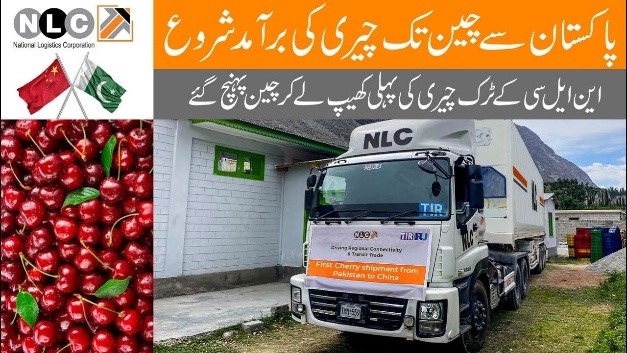
Cherries rank among the highest-value horticultural commodities in international trade, and China’s market — valued at approximately US$3 billion with annual demand of around 350,000 tonnes — represents the single most lucrative destination for cherry exporters worldwide. Pakistan’s Gilgit-Baltistan region produces approximately 5,000 tonnes of premium-quality cherries per season under ideal coolclimate conditions, yielding sweet, vibrantly coloured fruit harvested during a short seasonal window. Despite this natural advantage, Pakistan had historically been unable to access the Chinese cherry market: the proximity advantage and growing Chinese demand remained unrealised due to the absence of a phytosanitary protocol and orchard registration framework. This changed with the signing of the Pakistan–China Phytosanitary Agreement in November 2022, which granted Pakistan formal market access for fresh cherry exports. PHDEC, in coordination with the Trade Development Authority of Pakistan (TDAP), the Department of Plant Protection (DPP), and the National Logistic Cell (NLC), translated the protocol into operational reality within 18 months. PHDEC’s contribution centred on structured cherry product-development activities, including training Gilgit-Baltistan farmers in agricultural practices to improve production, fruit size, and quality, with particular focus on the black and French cherry varieties favoured by Chinese consumers. TDAP and DPP supported eligible orchard owners in registering with the General Administration of Chinese Customs (GACC), resulting in the successful registration of over 200 cherry orchards and a cold storage and packing facility at Rahim Abad. NLC provided the required reefer containers, with logistics costs financed through the Export Development Fund (EDF). On 5 June 2024, the first consignment of six tonnes of fresh Pakistani cherries was dispatched to China by reefer container, marking a landmark achievement for Pakistan’s horticulture export sector. Exports were subsequently scaled up to a target of 260 tonnes by the end of June 2024. PHDEC followed with a dedicated seminar in Gilgit on 3 October 2024, titled “Export of GB Cherries to China: Lessons Learned, Future Strategies,” bringing together the Agriculture Department, TDAP, exporters, and progressive growers. The seminar recorded strong participation from women farmers, processors, and traders, and established an aspirational target of 100,000 tonnes of GB cherry exports by 2030. PHDEC has since announced a complementary project on the development of high-demand cherry varieties in GilgitBaltistan to support this scale-up. The China market opening stands as one of PHDEC’s signature institutional successes — converting a long-standing trade aspiration into operational, recurring exports. Objectives • Operationalize the November 2022 Pakistan–China Phytosanitary Agreement on fresh cherries, converting the bilateral protocol into recurring export shipments. • Train Gilgit-Baltistan cherry farmers in production technology and good agricultural practices to improve the yield, fruit size, and quality of the black and French cherry varieties favoured by Chinese consumers. • Coordinate with TDAP, DPP, and NLC to ensure orchard GACC registration, phytosanitary compliance, and reefer container logistics for export consignments. • Position Pakistan’s cherry sector to secure a meaningful share of the US$3 billion, 350,000-tonne annual Chinese cherry market by leveraging the country’s geographic proximity advantage. • Establish a pipeline for high-demand variety development to support the long-term scale-up of GB cherry exports toward the 100,000-tonne target by 2030. • Demonstrate, through this market access achievement, the value of coordinated public-sector execution — PHDEC, TDAP, DPP, NLC, and EDF — in horticulture export development. Outcomes • First-ever consignment of six tonnes of fresh Pakistani cherries dispatched to China on 5 June 2024 — a historic milestone for Pakistan’s horticulture exports. • Over 100 GB cherry orchards plus a cold storage and packing house at Rahim Abad successfully registered with the General Administration of Chinese Customs (GACC). • Scale-up to a 260-tonne export target within the first month, validating the operational viability of the supply chain. • A trained Gilgit-Baltistan cherry farmer base equipped with PHDEC-disseminated technical guidance on producing the black and French varieties demanded by Chinese consumers. • Established lessons-learned framework via the October 2024 Gilgit seminar, with an aspirational 100,000-tonne by 2030 target and a follow-up high-demand variety development project announced.
Read More
Projects

Cherries Nurseries Project

PHDEC, with financial support from the Export Development Fund (EDF), has sponsored a Cherry Nursery Development Project in Gilgit-Baltistan to strengthen the region’s cherry production base and enhance its export potential. The project aims to develop a sustainable supply of quality, large-size and high-demand cherry plants for growers, with the long-term potential to provide up to 5 million plants annually. The initiative builds on the successful export of cherries from Gilgit-Baltistan to China and seeks to further improve production capacity, varietal quality and orchard productivity. The total project cost is Rs. 84.4 million, out of which Rs. 9.9 million has been released to the Mountain Agricultural Research Centre (MARC) for implementation of the project. Under the initiative, approximately 2.5–3.0 million quality cherry plants will be distributed among cherry growers through the Gilgit-Baltistan Agriculture Department, AKRSP and GBRSP. The project is expected to provide growers with improved planting material and contribute to the development of a commercially viable and export-oriented cherry value chain in the region. Objectives Develop and promote quality cherry nursery production in Gilgit-Baltistan. Provide growers with improved, high-demand and commercially suitable cherry plants. Strengthen the production base to meet growing domestic and export demand. Improve orchard productivity, fruit quality and varietal consistency. Facilitate the expansion of cherry cultivation in suitable areas of GB. Strengthen linkages among research institutions, nurseries, growers and development partners. Expected Outcomes Distribution of approximately 2.5–3.0 million quality cherry plants among growers. Increased availability of improved and high-demand cherry planting material. Expansion of productive cherry orchards across suitable areas of GB. Improved productivity, fruit quality and market competitiveness of GB cherries. Strengthened supply base for the growing China and other export markets. Development of a sustainable, export-oriented cherry value chain in Gilgit-Baltistan.  

Read More
Projects

Chili Solar Tunel Dryuers

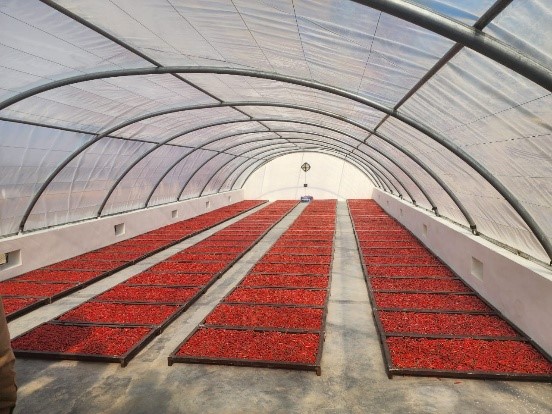
Chili is one of Pakistan’s most strategic spice commodities, with Sindh contributing the bulk of national production and Pakistani red chilies enjoying strong recognition for color, pungency and flavor. Yet a persistent and well-documented problem has held the sector back from realizing its export potential — aflatoxin contamination and Maximum Residue Limit (MRL) non-compliance arising from primitive open sun-drying practices on the ground, where chillies are exposed to fungal attack (Aspergillus flavus and Aspergillus parasiticus), insect damage, contamination, and inconsistent drying. Aflatoxins are recognised carcinogens with strict international permissible limits (under 5 ppb under WTO norms), and Pakistani chili consignments have repeatedly faced rejection or down-grading in premium destinations because of this single quality bottleneck. PHDEC’s response has been to establish solar tunnel drying units distributed to chili growers across Sindh’s major producing districts — funded through the Export Development Fund (EDF) and rolled out in collaboration with the Arid Zone Research Centre (AZRC), Umerkot. The project covers 34 solar tunnel drying units sited across the province’s chili belt, providing a sustainable, low-operating-cost, scientifically-validated drying solution. Solar tunnel dryers maintain controlled airflow and temperature, materially reducing drying time, inhibiting fungal growth, preserving colour and capsaicin content, eliminating ground-level contamination, and producing uniformly dried chillies that meet international aflatoxin and MRL standards. PHDEC paired the equipment roll-out with a one-day technical workshop at AZRC Umerkot covering aflatoxin control, MRL compliance, and Good Agricultural Practices (GAP) for chili cultivation, ensuring growers have both the hardware and the know-how to operate it correctly. The intervention directly targets the niche premium markets where Pakistani chili has been priced out by quality compliance issues — high-value EU and other destinations that demand traceable, residue-compliant, aflatoxin-free product. Beyond the immediate beneficiaries, the project serves as a demonstration model for sustainable, climate-friendly post-harvest infrastructure that can be scaled across other dried produce categories. Objectives Eliminate aflatoxin contamination in Sindh’s red chili production by replacing open ground-level sun drying with controlled solar tunnel drying. Bring Pakistani chili consignments into compliance with importing-country Maximum Residue Limits (MRLs) and international aflatoxin permissible levels (under 5 ppb). Capture niche, premium export markets — particularly the EU — that currently reject or down-grade non-compliant Pakistani chili. Provide chili growers with a sustainable, low-operating-cost, climate-friendly post-harvest infrastructure that materially improves drying quality and consistency. Pair the equipment intervention with technical capacity building on aflatoxin control, MRL compliance and Good Agricultural Practices for chili cultivation. Anchor a replicable, scalable model of EDF-funded post-harvest infrastructure that can be extended across other dried-produce categories in Pakistan’s horticulture sector. Outcomes 22 solar tunnel drying units established across Sindh’s major chili-producing districts, directly serving progressive growers and processors.

Read More
Projects

Mango Dehydration Facility at MNSUAM, Multan (EDF-funded)

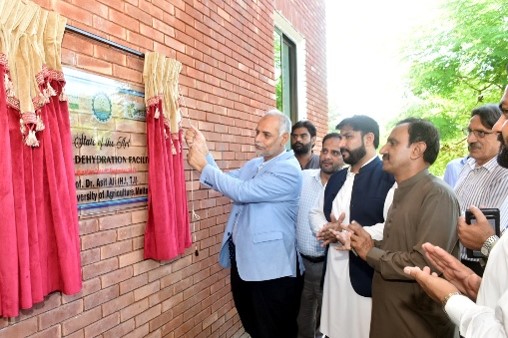
Multan — Pakistan’s “Mango City” — sits at the heart of a mango sector that produces approximately 1.8 million metric tons annually but exports only 6–7% as fresh fruit, with the remainder absorbing huge post-harvest losses or sold at distress prices during seasonal gluts. Recognizing that value addition through dehydration is one of the most direct routes to absorbing surplus production, generating higher-value export products and opening new market segments (dehydrated mango cubes, slices, powders, pulp products), PHDEC has executed the establishment of a state-of-the-art Mango Dehydration Facility at the Muhammad Nawaz Shareef University of Agriculture, Multan (MNSUAM) — funded through Pakistan’s Export Development Fund (EDF). The facility was formally inaugurated on 9 September 2025 in Multan, in partnership with MNSUAM as the host academic institution. It is conceived as more than a processing unit — it is an Integrated Value Addition Unit serving simultaneously as a working production facility and a teaching, demonstration and applied-research platform for students, faculty, processors and entrepreneurs from across Pakistan’s mango belt. The technical configuration covers the full dehydration process — sorting, washing, slicing, blanching, drying and nitrogen-flushed packaging — at industrial-relevant scale. PHDEC has paired the inauguration with a complementary workshop on “Branding and Packaging of Value-Added Horticultural Products to Compete in High-End International Markets” held at MNSUAM in November 2025, addressing the downstream challenges of nitrogen flushing protocols, packaging materials, label design and brand positioning required to convert dehydrated mango into a premium export product. The project is now fully operational and represents a major institutional collaboration between the federal export-promotion mandate (PHDEC, EDF, Ministry of Commerce) and provincial academia (MNSUAM). It directly anchors PHDEC’s broader EDF-supported infrastructure programme of 37 value-added projects across provinces, and is being positioned by the company as a replicable demonstration model that can be scaled to additional mango districts. Vice Chancellor MNSUAM Dr Asif has publicly appreciated PHDEC’s role in linking academia and industry for export-led growth — a partnership model that PHDEC intends to extend to other crops and host institutions. Objectives Establish Pakistan’s first dedicated, university-hosted mango dehydration facility as a working demonstration of industrial-scale mango value addition. Address the chronic problem of post-harvest losses and seasonal gluts in Pakistan’s 1.8 MMT mango sector by absorbing surplus fruit into a higher-value processing pipeline. Convert Pakistani mango from a near-exclusively fresh-fruit export (6–7% of production) into a diversified export basket including dehydrated cubes, slices, pulp and powders. Build local technical capacity through a hands-on training and applied-research platform serving students, faculty, processors and entrepreneurs from across the mango belt. Anchor PHDEC’s broader EDF-funded portfolio of 37 value-addition infrastructure projects with a high-visibility, scalable flagship model. Strengthen the strategic federal–provincial and academia–industry partnership between PHDEC and MNSUAM as a template for future PHDEC infrastructure interventions. Outcomes State-of-the-art mango dehydration facility inaugurated on 9 September 2025 at MNSUAM, fully operational and producing export-ready dehydrated mango product. Reduction in seasonal post-harvest losses for the Multan mango belt, with surplus fruit absorbed into a value-addition pipeline rather than sold at distress prices. A trained pool of MNSUAM students, faculty, processors and entrepreneurs gaining hands-on exposure to industrial-scale dehydration, packaging and quality protocols. Complementary branding and packaging workshop completed in November 2025, addressing nitrogen-flushing, label design and shelf-life issues for premium positioning. A replicable demonstration model that PHDEC can extend to other mango districts and other commodities — strengthening Pakistan’s broader value-addition infrastructure base.

Read More
Projects

Banana Bagging Project

Today (June 13, 2024) Pakistan Horticulture Development & Export Company Distributed Banana Bags with the aim to enhance Pakistan’s Banana Exports through Quality Improvements.Recognizing the potential of banana crop, the Pakistan Horticulture Development & Export Company (PHDEC) has initiated a pilot project to distribute banana bunch bags to progressive growers in Hyderabad region. This initiative aims to enhance the quality and cosmetic appeal of bananas, facilitating their entry into more lucrative international markets. PHDEC’s ongoing efforts focus on advancing Pakistan’s horticulture sector by improving the quality of horticultural products to boost exports.The Sindh province is a major contributor, covering 93% of the banana cultivation area and producing 83% of the country’s bananas. Mostly, Cavendish banana variety is produced in Sindh cluster, due to climate change effects, the high temperature causes physiological disorder of banana with quality defects such as chilling injury and sun born, which affects visual appearance of the fruit and fetch low prices in the international market. This banana bunch activity will not only reduce these affects, but will help in diversifying product to the niche market.Pakistan, a significant banana producer with approximately 33 thousand hectares of banana cultivation, is exporting this fruit to Iran and the Central Asian Republics (CARs). However, Improving the cosmetic appeal and overall quality of bananas is crucial for accessing higher-value markets. The distribution of banana bunch bags by PHDEC represents a strategic move towards this goal. In 2023, Pakistan exported $52 million worth of bananas.In addition to distributing the bags, PHDEC, in collaboration with the Agriculture Research Department in Tandojam, also organized a seminar on banana bagging and good agricultural practices. Held at the auditorium hall of the Agriculture Research Department, the seminar addressed key issues from production to post-harvest management and export marketing.Mr. Athar Hussain Khokhar, CEO of PHDEC, said that banana has emerged as potential export crop after citrus and mangoes. Growing international demand requires following good agriculture practices. He said that Pakistan is 5th worst climate affected country, and our fruit and vegetable is directly bearing the brunt of this climate change. We need to adapt and make required changes in our field practices for reducing field losses. Banana bagging initiative is one of such activity, which will control physiological disorder in the crop. He said that earlier PHDEC had also initiated mango bagging activity, which has received positive response from our growers in Multan and Hyderabad region.Mr. Niaz Ahmad Nizamani, a progressive banana grower and value chain expert, guided growers on effective banana bunch bagging techniques. He delivered a detailed presentation on the types of bags, their benefits, and installation procedures, emphasizing that bagging is essential for improving the fruit’s cosmetic appeal.Dr. Abdul Mubeen Lodhi, Professor at the Department of Plant Protection, Sindh Agriculture University, provided a detailed analysis of current crop conditions and good agricultural practices. He discussed the reasons behind low production levels in Pakistan and the impact of malpractices, offering insights into Panama disease, its symptoms, and control measures.

Read More
Projects

Mango Project in Multan and Rahim Yar Khan (RYK)

Today (May 15, 2024), the Pakistan Horticulture Development and Export Company (PHDEC) distributed approximately 80,000 mango bags to progressive growers in Multan and Rahim Yar Khan (RYK). The Mango Bagging initiative, launched in 2023 with the distribution of 150,000 bags in Sindh and Punjab, received positive feedback for enhancing fruit quality and appearance. Building on this success, PHDEC has distributed an additional 150,000 bags this season (2024), with 70,000 bags to Sindh and 80,000 to Multan.

Read More
Projects Seminars

Mango Bagging initiative to boost the Mango industry of Pakistan

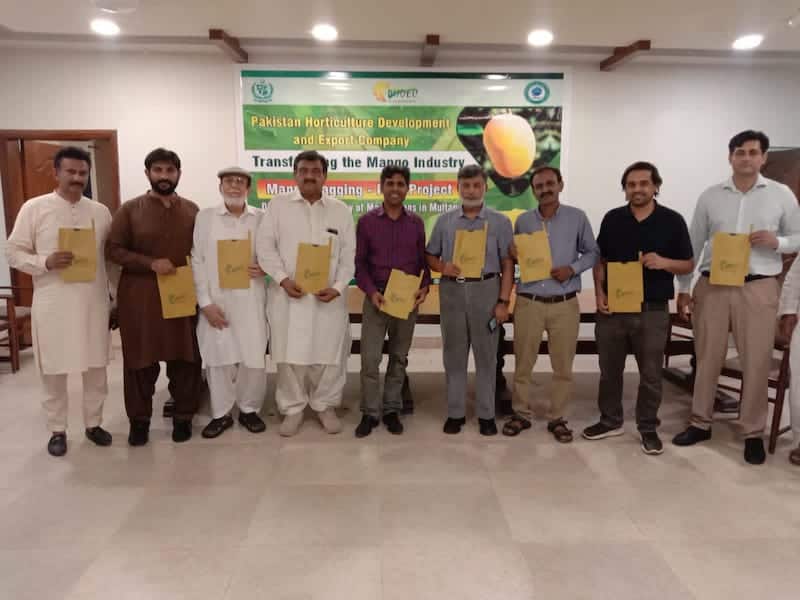
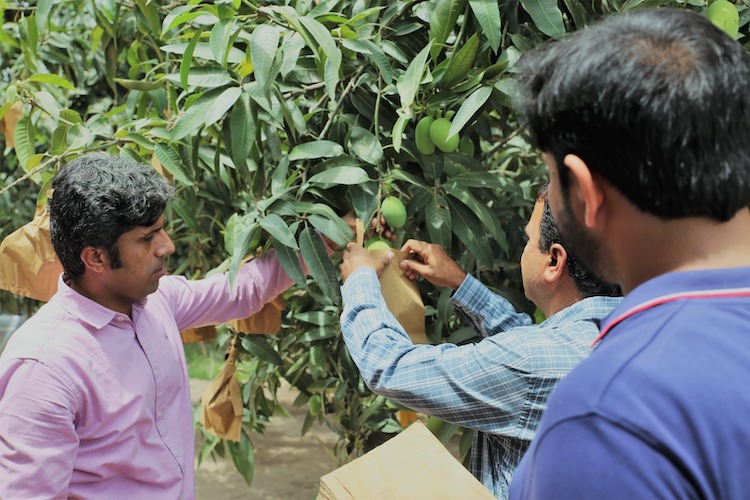
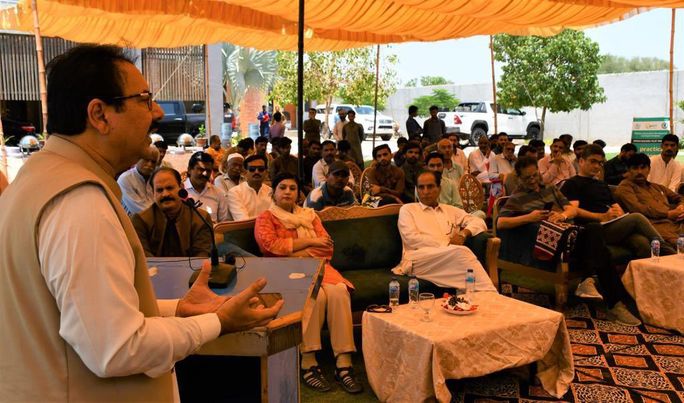
The Mango Bagging initiative, piloted in 2023 received positive feedback for improving fruit quality and appearance. Following its success, PHDEC distributed an additional 150,000 bags this season (2024).Despite being the fifth-largest mango-producing country, only 6-7% of Pakistan’s mango production is exported fresh. The bagging initiative aims to increase exports by enhancing fruit quality, making Pakistani mangoes more competitive in high-end international markets.Mr. Athar Hussain Khokhar, CEO of PHDEC, highlighted the pilot project’s importance and emphasized collaboration with stakeholders to enhance mango quality, increase market share, and boost exports to high-end markets.Keynote speaker Dr. Javed Iqbal, Senior Scientist from Mango Research Station (Shujabad) provided insights on mango orchard management and the benefits of mango bagging for yield and quality. He further highlighted the significant commercial advantages of Mango Bagging, including the reduction of post-harvest diseases and damages, preservation of fruit color, decreased reliance on additional pesticide spraying and protection against pests such as fruit flies, especially given their status as quarantine pests. He recommended a bagging duration of 30-45 days for mango fruit.Mr. Mahmood Nawaz Shah, President Sindh Abadagar Board, and Mr. Nadeem Shah, Vice President, Sindh Abadagar Board, lauded PHDEC’s initiative, expecting positive outcomes for growers and Pakistani mango exports.Mr. Khawar Nadeem, Manager Agri Products PHDEC, thanked the participants for their time and further re-iterated PHDEC’s dedication in promoting and enhancing the horticulture sector in Pakistan through innovative initiatives and strategic collaborations.

Read More
Projects

Mango Bagging at Lutafabad Mango Farms

After the successful launch of its “Pilot Project on Mango Bagging” in Sindh, PHDEC launched the second phase of “Mango Bagging” at Lutfabad Mango Farms, Multan. Selective progressive Mango growers/exporters of Multan region were invited to take part in the launching. Mango Bagging has important commercial benefits in reducing postharvest diseases & damages, preservation of fruit’s color, reduction in spraying additional pesticides, protection of the fruit from birds and insects and protection from climate change hazards.

Read More
Projects

Mango Bagging Projects

Mango Bagging Project PHDEC kicked off “the Pilot Project on Mango Bagging” in collaboration with Sindh Agriculture University, Tandojam, Sindh Abadgar Board, Sindh Mango Growers Association and Genuine Delight Farms.  The launching ceremony was held at Genuine Delight Farms, Tando Allah Yar where a large number of progressive mango growers, representatives from Sindh Agriculture Department, R&D, and Academia witnessed the ceremony.  PHDEC has provided 75,000 mango bags to growers /mango exporters for improving quality of the mangoes to fetch higher prices in high end International markets. Project Kickoff Media Coverage https://phdec.gov.pk/wp-content/uploads/2023/05/mango-bagging-project-news2.mp4https://phdec.gov.pk/wp-content/uploads/2023/05/mango-bagging-project.mp4https://phdec.gov.pk/wp-content/uploads/2023/05/mango-bagging-project-news.mp4 Print Media [foogallery id=”12527″]

Read More